
Corporate and Franchisee QSR Spread Reflects More Than Tenant Credit Date October 14, 2026
The 97 basis point spread between corporate and franchisee QSR cap rates is typically viewed as a credit premium. Broken out by remaining lease term, the spread reflects three separate premiums, and only one is primarily tied to the franchisee credit.
By Randy Blankstein, President, The Boulder Group
Key Takeaways
- Corporate QSR asking cap rates averaged 5.90% and franchisee QSR asking cap rates averaged 6.87% in the third quarter of 2026, a spread of 97 basis points.
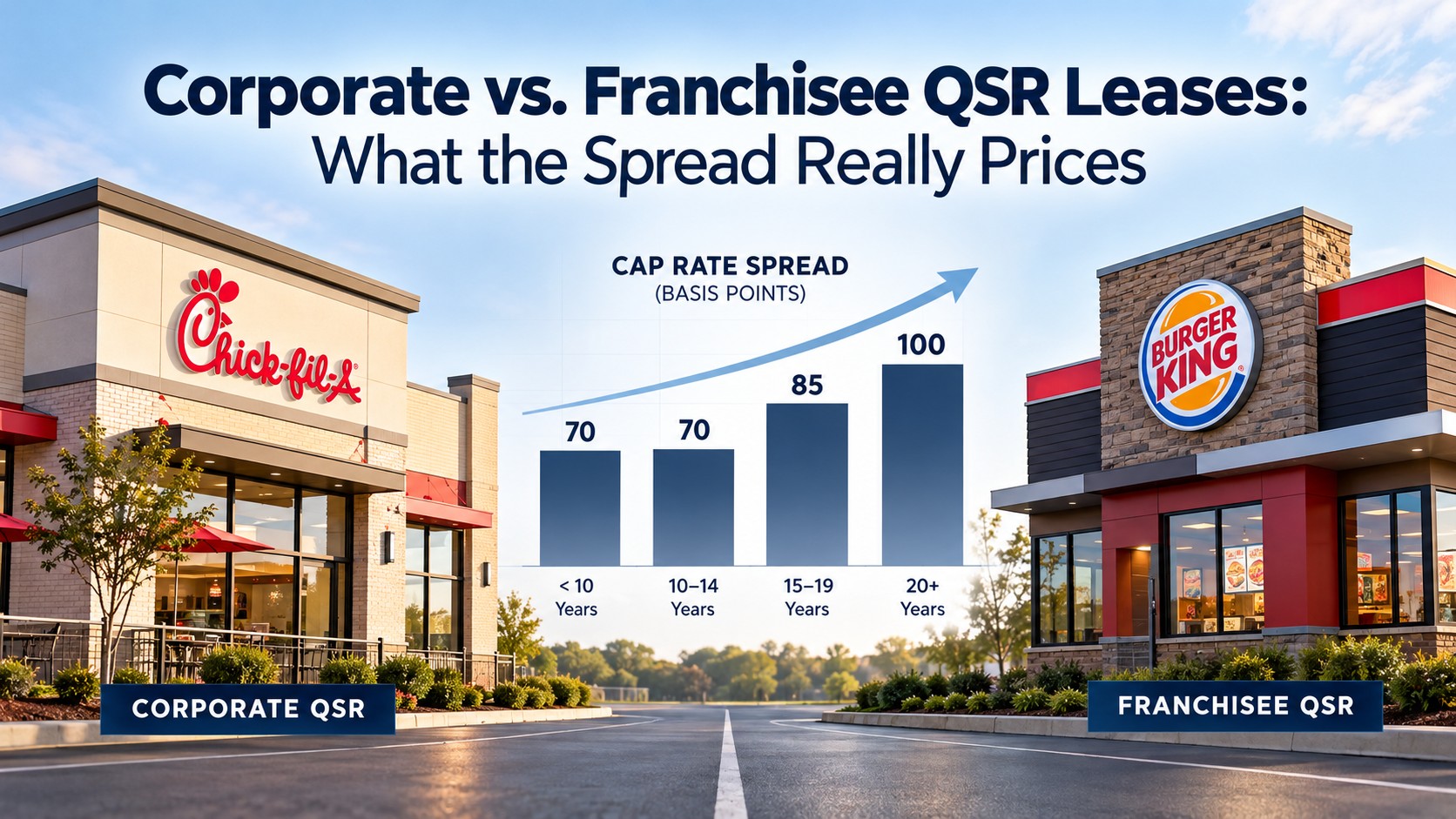
- The spread scales with remaining lease term: 100 basis points for leases with 20+ years remaining, 85 basis points at 15 to 19 years and 70 basis points below 15 years.
- Since the first quarter of 2026, the spread for leases with 20+ years remaining widened by 10 basis points, entirely on franchisee pricing, while the spread for leases under 10 years tightened slightly.
- The spread prices three factors (the duration of the guaranty, liquidity at resale and the underwriting required of the next buyer), not franchisee default risk alone.
- The spread does not price store level performance, which determines which leases survive a franchisee bankruptcy.
Third Quarter 2026 QSR Pricing
Corporate QSR asking cap rates increased to 5.90% (+5 bps) in the third quarter of 2026 while franchisee QSR asking cap rates increased to 6.87% (+2 bps), according to The Boulder Group’s Q3 2026 Net Lease Research Report. As a result, the spread between corporate and franchisee QSR narrowed by three basis points to 97 basis points when compared to the prior quarter. This occurred in a quarter when overall single tenant net lease cap rates increased by 10 basis points to 6.92%. For reference, McDonald’s and Chick-fil-A ground leases had asking cap rates of 4.50%, which remains the most aggressive pricing in the QSR sector.
The 97 basis point spread is commonly treated as a single credit premium paid for accepting a weaker tenant. However, the spread reflects three separate premiums stacked on top of one another, and only one is primarily tied to the franchisee credit. Investors who price franchisee deals off the headline spread will overpay for some assets and pass on others they should own. The breakdown by remaining lease term shows where the premium actually sits.
| Remaining Lease Term | Corporate QSR | Franchisee QSR | Spread |
| 20+ years | 5.00% | 6.00% | 100 bps |
| 15–19 years | 5.55% | 6.40% | 85 bps |
| 10–14 years | 6.15% | 6.85% | 70 bps |
| Under 10 years | 6.85% | 7.55% | 70 bps |
| All QSR (average) | 5.90% | 6.87% | 97 bps |
Source: The Boulder Group, Q3 2026 Net Lease Research Report. Term buckets are national median asking cap rates; the All QSR row is the sector average.
Spread by Remaining Lease Term
The spread is widest for the longest leases. Leases with 20+ years remaining carried a 100 basis point spread (5.00% corporate and 6.00% franchisee), which declined to 85 basis points at 15 to 19 years and 70 basis points once fewer than 15 years remained. If the market were pricing only the likelihood of a franchisee default in the near term, the premium would be relatively uniform across lease terms. Instead, the premium scales with the number of years of rent the guaranty is expected to support.
The headline spread also masks the direction of the market. While the overall QSR spread narrowed in the third quarter, the spread for long term leases widened. In the first quarter of 2026, the spread was 90 basis points for leases with 20+ years remaining (5.00% corporate and 5.90% franchisee) and 72 basis points for leases under 10 years. By the third quarter, the long term spread increased to 100 basis points while the short term spread decreased to 70 basis points. Corporate cap rates for leases with 20+ years remaining held at 5.00% over that period, so the entire increase came from franchisee pricing.
What the Spread Prices
1. Duration of the Guaranty
A guaranty is only as valuable as the rent it covers and the strength of the guarantor over the full lease term. On a corporate lease, the guarantor in year 15 will almost certainly be the same company underwritten at closing. On a franchisee lease, that is often not the case, as franchisee groups consistently buy, sell, recapitalize and consolidate units. Superior Star, a Hardee’s operator, acquired 93 restaurants in 2023, closed approximately 30 of them and filed for Chapter 11 in July 2026 with 59 units remaining. The operating entity underwritten at the time of acquisition looked considerably different by the time of the filing.
Accordingly, long term franchisee leases carry a premium for both default risk and the risk that the credit itself changes. This is the reason the long end of the spread moves first during a period of stress, and 2026 has been one. At least ten significant multi-unit franchisee bankruptcies have been recorded this year across brands including Popeyes, Hardee’s, Carl’s Jr., Subway and Applebee’s. Over the same period, the spread for leases with 20+ years remaining widened by 10 basis points while the short term spread tightened slightly. Investors are not repricing franchisee risk across the board, but they are limiting how far into the future they are willing to rely on it.
2. Liquidity at Resale
Corporate QSR assets resell into the deepest buyer pool in net lease (1031 exchange buyers, private wealth, family offices, institutions and lenders willing to finance the asset with limited debate). Franchisee QSR assets resell to the smaller segment of that pool willing to repeat the underwriting. The next buyer will require the operator’s financials, unit count and guaranty language, along with clarity on whether the guaranty burns off. Fewer qualified buyers result in longer marketing times and more re-trades.
Consequently, part of the spread is a liquidity discount that investors collect at acquisition and partially give back at disposition. For investors with a long hold period, collecting that discount is a sound strategy. Investors with a five to seven year hold period will need to underwrite the exit cap rate as carefully as the entry cap rate, as the asset will have a shorter remaining lease term and still be backed by a franchisee at the time of sale.
3. Underwriting Requirements
Underwriting a corporate QSR lease largely involves a review of public filings. Underwriting a franchisee QSR lease requires answers to questions many buyers never ask (guarantor entity, unit count, quality of financial statements, personal guaranty and burn-off provisions, cross-default provisions and rent as a percentage of store sales). The guarantor may be the operating company, a holding company or a single purpose entity that owns one store, and its financials may be audited, reviewed or self-prepared. Many investors are unable or unwilling to complete this work, and the spread compensates the investors who do. As a result, two franchisee deals priced at the same cap rate can carry significantly different risk, while two deals 75 basis points apart can carry similar risk.
What the Spread Does Not Price: Store Performance
When a franchisee files for Chapter 11, the bankruptcy code generally allows the operator to assume or reject each lease individually. Profitable stores are retained or sold to another operator, while underperforming stores are returned to the landlord. Both outcomes occurred in 2026. Sailormen, a 136-unit Popeyes franchisee, filed in January, and by June the court approved the sale of 97 of its restaurants to multiple buyers including Restaurant Brands International, the parent company of Popeyes. Inversely, ARC Burger, a 77-unit Hardee’s operator, closed every location and filed for Chapter 7 in April. Both were franchisee credits, and the outcome for each landlord depended on whether the store was one another operator wanted to keep open.
Accordingly, rent as a percentage of store sales is the variable to underwrite most carefully. A franchisee lease on a high volume store with sustainable occupancy costs often carries less risk than its cap rate implies, as it is the lease every party in a restructuring wants to keep. It is important to note that a corporate lease shifts store level risk rather than eliminating it. A corporate tenant can go dark and continue paying rent, which protects the income stream but not the real estate, and the residual value question comes due at lease expiration.
Where the Spread Is Mispriced
The spread is often too wide for long term leases with large multi-unit operators that provide audited financials and an operating company guaranty. The same applies to strong real estate with market or below market rent, where a re-tenanting scenario is manageable, and to brands whose franchisors have shown they will take over distressed units rather than allow them to go dark. However, the spread is often too narrow for short term corporate deals priced on the brand, where the renewal decision is the primary underwriting question. Franchisee sale-leasebacks with above market rent and a personal guaranty that burns off after a few years fall into the same category. Recently acquired franchisee portfolios also carry more risk than the spread implies until the operator proves it can absorb the units it acquired.
Implications and Outlook
1031 exchange and private investors will be better served pricing a franchisee deal off remaining lease term, guaranty structure and rent as a percentage of store sales than off the headline spread, with rent-to-sales as the deciding factor. A higher cap rate only represents additional yield if the store is one the current operator, or the next operator, will fight to keep. For institutions and family offices, the spread is partially compensation for underwriting capacity. Investors that build that capacity will find franchisee QSR to be a durable source of excess yield, while those that do not will face adverse selection.
Franchisee operators considering a sale-leaseback control each item on the underwriting list. Financial transparency, an operating company guaranty rather than a single store entity, a longer lease term and market rent each move franchisee pricing closer to corporate levels. Pushing rent above market to maximize sale-leaseback proceeds is the fastest way for an operator to widen its own spread.
Multi-unit franchisee bankruptcies will continue to shape franchisee QSR pricing through the remainder of 2026. Investors will be carefully monitoring which leases are assumed and which are rejected in pending cases, as those outcomes set the reference point for store level underwriting. The expectation is that the spread for leases with 20+ years remaining will stay under upward pressure while franchisee bankruptcies continue at the current pace. Corporate QSR and ground lease assets with McDonald’s and Chick-fil-A will continue to command the most aggressive pricing in the sector, while franchisee assets with strong store sales and transparent operators will trade inside the average spread.
Randy Blankstein is President of net lease advisory firm The Boulder Group. http://bouldergroup.com/
Frequently Asked Questions
What is the current cap rate spread between corporate and franchisee QSR leases?
According to The Boulder Group’s Q3 2026 Net Lease Research Report, corporate QSR asking cap rates averaged 5.90% and franchisee QSR asking cap rates averaged 6.87%, a spread of 97 basis points. The spread varies by remaining lease term: 100 basis points on leases with 20+ years remaining, 85 basis points at 15 to 19 years and 70 basis points on leases with fewer than 15 years remaining.
Why do franchisee QSR leases trade at higher cap rates than corporate QSR leases?
The spread compensates investors for three things: the risk that the franchisee guarantor weakens or changes over a long lease term, a thinner buyer pool at resale and the additional underwriting required to evaluate a private operator. It is not a pure measure of default risk.
Are franchisee QSR leases riskier than corporate QSR leases?
Often, but not uniformly. A long term lease with a large, transparent multi-unit operator on a high volume store can carry less practical risk than its cap rate suggests, while a corporate lease near expiration can carry more. Remaining lease term, guaranty structure and rent as a percentage of store sales matter more than the corporate or franchisee label alone.
What happens to a franchisee QSR lease if the operator files for bankruptcy?
In a Chapter 11 case, the operator can generally choose to assume or reject each lease. Leases on profitable stores are typically kept or assigned to a buyer as part of a sale, while leases on underperforming stores are more likely to be rejected and returned to the landlord. In a Chapter 7 liquidation, locations are typically closed.
Franchisee bankruptcy details are drawn from public court filings and industry trade coverage. This article is for informational purposes and is not investment, legal, or tax advice.
Back