
Off-Market NNN in a 1031 Exchange: How Buyers Get Access Without Breaking the 45/180-Day Rules Date October 27, 2026
By Randy Blankstein, Founder & President, The Boulder Group
The short answer: Off-market net lease properties can be excellent 1031 replacement candidates, but only when the search starts before the relinquished property sale closes and the off-market deal is backed by credible listed alternatives. The approach I recommend is the 1 + 2 Identification Strategy: identify one off-market target and two fully or quietly marketed backups on your 45-day list.
Key takeaways
- Off-market access widens a 1031 buyer’s options, but access is not certainty. A deal that falls apart after day 45 can cost you the exchange, not just the property.
- Start sourcing when the decision to sell becomes serious, and engage your Qualified Intermediary before the sale closes.
- Evaluate the seller as carefully as the property: authority, motivation, documents and a realistic closing date.
- Use the 1 + 2 Identification Strategy so that one failed deal does not sink the exchange.
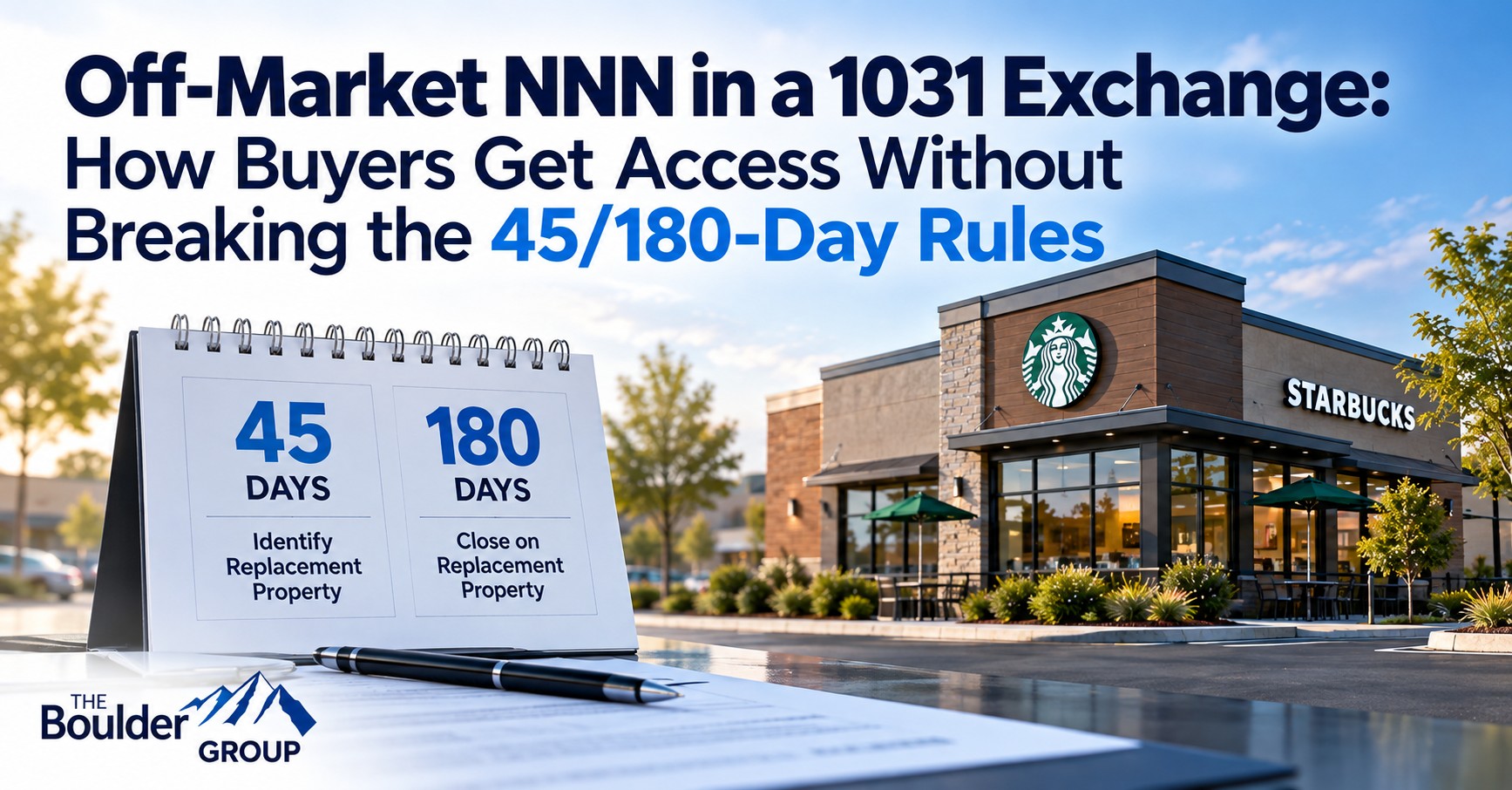
The day a 1031 exchanger closes on a relinquished property, two clocks start. You have 45 days to identify replacement property and 180 days to close on it. Neither clock stops for weekends, holidays or a seller who changes his mind.
Under that pressure, off-market inventory looks very attractive: fewer competing buyers, a direct line to the owner, and possibly a better fit than anything listed. That is why exchangers are so often pitched “exclusive” deals.
The catch is that a property can meet every investment requirement and still be an unrealistic replacement candidate. The owner may be interested in a conversation but unprepared to negotiate a contract, deliver documents or commit to a closing date. For an exchange buyer, off-market access is only as valuable as its ability to produce an executable transaction within the available time. Here is how to pursue off-market net lease while keeping the exchange protected.
What Are the 45-Day and 180-Day Rules in a 1031 Exchange?
The core timing rules for a deferred exchange come from Section 1031 of the Internal Revenue Code and the Treasury regulations under it (Treas. Reg. §1.1031(k)-1). They are summarized in the IRS Instructions for Form 8824, the form used to report the exchange, and in IRS Publication 544.
- Identification period: Replacement property must be identified within 45 calendar days after the transfer of the relinquished property.
- Exchange period: Replacement property must be received by the earlier of 180 calendar days after the transfer or the due date (including extensions) of your tax return for the year of the transfer. The two periods run concurrently; the 180 days is not 45 plus 180.
- Written identification: The identification must be in writing, signed by you, and delivered before the deadline to a person involved in the exchange who is not a disqualified party, typically your Qualified Intermediary (QI). The property must be described unambiguously, such as by legal description or street address.
- How many properties: Most exchangers rely on the three-property rule (identify up to three properties regardless of value). Alternatives include the 200% rule (any number of properties whose combined value does not exceed 200% of the relinquished property’s value) and the 95% rule, which carries its own strict requirements.
- Changes: An identification can generally be revoked and replaced in writing before the 45-day period ends. After day 45, your list is your list.
There is no general extension for a deal that runs late; the narrow relief that exists (such as for federally declared disasters) is not something to plan around.
The practical implication: the 45-day list is the single most important document in your exchange. Everything that follows is about building a list that survives a failed deal.
What Does “Off-Market” Mean in Net Lease?
The phrase “off-market” is used loosely. As I wrote in The Off-Market Net Lease Market Is Bigger Than You Think, it is more useful to think about the net lease market in three categories:
- Fully marketed properties. The owner has made a formal decision to sell. An offering memorandum has typically been prepared, pricing expectations have been established and the property is broadly exposed to prospective buyers.
- Quietly marketed properties. The seller intends to transact but has chosen to limit exposure. A broker or advisor may approach a small group of investors believed to have a high probability of executing.
- Truly off-market properties. The owner has not formally put the property up for sale. There may be no offering memorandum, asking price or defined sales process. The owner, however, may be willing to sell if approached with the right combination of price, terms and certainty of closing.
For a 1031 buyer, these tiers carry very different levels of execution risk. A fully marketed property has a seller who has already decided. A quietly marketed property has a seller who has decided but wants discretion. A truly off-market property has an owner who has decided nothing yet.
Why Do 1031 Buyers Pursue Off-Market Net Lease?
Exchangers usually have narrow requirements: a price range that matches their proceeds and debt replacement, preferred tenants, minimum remaining lease term, specific geographies. Restricting the search to whatever happens to be listed during a 45-day window shrinks the opportunity set considerably.
The listed market is not small. The Boulder Group’s Q3 2026 National Net Lease Research Report counted 5,754 single-tenant net lease properties on the market, with the overall asking cap rate rising 10 basis points to 6.92%. But only a fraction of those listings fit any one buyer’s criteria. An off-market approach reverses the search: start with the properties that meet your criteria, then find out whether the owners would sell.
What Can Go Wrong With an Off-Market Replacement Property?
The same features that create the opportunity create the risk:
- Seller retrades. An owner who was not planning to sell can reconsider at any point, after a family conversation, a tax review or a second thought on price. No marketing process anchors them.
- Missing lease files. Off-market owners often do not have a diligence package ready. Leases, amendments, estoppels, rent rolls, CAM reconciliations and surveys may take weeks to assemble, and that time comes out of your 180 days.
- Financing friction. An acquisition that works with all cash may be difficult to complete if the lender requires additional tenant information, substantial reserves or more time than the seller will allow.
- No backup. Buyers who fall in love with a single off-market deal sometimes identify it alone, or pad the list with properties they never seriously vetted.
- False exclusivity. A deal marketed as “exclusive” may be shopped to many buyers, may not come with the owner’s actual authorization to sell, or may be represented by someone with no relationship to the decision maker.
- Rushed diligence. Deadline pressure encourages shortcuts. Tenant and guarantor, landlord responsibilities, lease options, assignment provisions and rights of first refusal still need review, along with title, environmental, survey, estoppel and financing requirements.
A hypothetical example. Consider a buyer seeking a net lease property around $4 million. An advisor identifies an unlisted asset with the preferred tenant and lease term. The owner expresses interest, but a partner has not approved the sale, a lease amendment is missing and the seller wants to find another investment before committing. The property may eventually trade, but the exchange buyer cannot confidently build a closing plan around it yet. Spending most of the identification period waiting for those issues to resolve can leave too little time to evaluate alternatives.
When Should a 1031 Buyer Start Sourcing Off-Market Properties?
Begin defining the replacement-property strategy when the decision to sell becomes serious, not after the relinquished property closes. Off-market sourcing may require identifying the actual decision maker, establishing price expectations, obtaining lease documents and resolving an owner’s uncertainty about selling. Once the relinquished property is under contract, the search should be active enough to test availability and pricing against your requirements.
Engage a Qualified Intermediary and your tax and legal advisors before the sale closes. A property search does not establish an exchange, and receiving or controlling the sale proceeds yourself can jeopardize the intended tax treatment.
An effective search mandate covers more than a price range and a target cap rate:
- Tenant and guarantor requirements
- Minimum remaining lease term and rent increases
- Acceptable landlord obligations
- Geography and underlying real estate criteria
- Financing needs and lender requirements
Separate essential requirements from preferences. A buyer may be flexible on geography while unwilling to accept a franchisee guaranty or a near-term lease expiration. Making those distinctions early reduces time spent on properties you will ultimately reject.
The 1 + 2 Identification Strategy
The framework I recommend for exchangers pursuing off-market net lease is simple: identify one off-market target and two fully or quietly marketed backups. I call it the 1 + 2 Identification Strategy. It works within the three-property rule and keeps the upside of off-market access without betting the exchange on it.
- Set criteria before your sale closes. Use the search mandate above. Without it, neither the off-market search nor the backups have direction.
- Select one off-market primary target. This is the property you would most like to own, ideally a quietly marketed or truly off-market asset where the owner has confirmed willingness to sell and you have reached a price and terms understanding.
- Select two listed backups. Choose fully marketed (or credibly quietly marketed) properties with motivated sellers, complete diligence packages and pricing you would actually accept. A backup whose lease terms are unknown or whose seller has never confirmed availability offers little protection.
- Identify the off-market target before a contract if needed. Nothing in the identification rules requires a signed purchase agreement. If the target is unambiguously described and the timing requires it, it can go on your 45-day list while the contract is still being negotiated. The trade-off is that you are identifying a property you do not yet control, which is exactly why the backups matter.
- Keep the backups warm through day 45 and beyond. Maintain communication, submit offers or letters of intent where appropriate, and know what it takes to get each one under contract quickly.
- Re-evaluate before day 45. If the off-market deal is wobbling, revoke and re-identify in writing while you still can. Day 40 is a decision point, not a formality.
- Coordinate everything with your QI. The identification must be delivered correctly and on time. Confirm the form, the delivery method and the deadline in writing.
Compare every candidate against the same investment and execution standards. A listed property with complete documentation and a realistic seller may be more suitable for an exchange than an attractive unlisted property whose owner remains undecided. Backups are not a lack of commitment to the off-market deal. They let you negotiate it from strength instead of desperation.
How Do You Know an Off-Market Seller Will Actually Close?
Before you rely on an off-market property as your primary replacement, confirm:
- The person you are negotiating with is the decision maker (or has written authority) for the ownership entity, and all partners, members or trustees are aligned.
- You understand why the owner is willing to sell now: a loan maturity, estate planning, portfolio rebalancing or another concrete reason.
- Price and terms in writing. A signed letter of intent at minimum, with a clear path to a purchase agreement on a defined timeline.
- Lease file. Full lease, all amendments, guaranty, current rent information and any assignment documents are in hand or have a committed delivery date.
- Tenant estoppel. Timing and process for obtaining an estoppel are agreed, including any lease-required response periods.
- Rights of first refusal or offer. The lease has been checked for tenant ROFR/ROFO provisions that could delay or block the sale.
- Title, survey, environmental and existing debt. Title ordered early; payoff, prepayment or defeasance requirements understood.
- Seller’s dependencies. The seller’s closing does not hinge on an unresolved loan payoff, tenant action or their own replacement purchase. If the seller is exchanging, their timing fits yours.
- Your lender’s requirements, such as tenant financials, reserves and appraisal timing, fit inside the seller’s timeline.
- Closing date inside your window. The contract leaves cushion before day 180 (or your return due date, if earlier).
- Backups confirmed. Your two listed alternatives remain available and are properly identified.
What Are the Red Flags in an Off-Market Net Lease Deal?
- An “exclusive” deal that the presenter cannot connect to the owner’s written authorization.
- No offering memorandum or lease abstract, and no willingness to share the lease.
- An owner who will not sign a letter of intent or keeps postponing a purchase agreement.
- Pricing that moves after you have identified the property.
- Pressure to identify only one property.
- A diligence period proposed by the seller that does not fit inside your exchange timeline.
- A tenant ROFR that no one has addressed.
FAQ
Can an off-market property be identified before a contract exists?
Yes. The identification rules require a written, signed, unambiguous description delivered on time, not a signed purchase agreement. Identifying a property you do not control carries risk, which is why it should be paired with credible backups. Confirm the mechanics with your Qualified Intermediary.
How many backups should I have?
Under the three-property rule, the practical answer is two, which is the basis of the 1 + 2 Identification Strategy. Exchangers using the 200% rule may identify more, but every property on the list should be one you would actually buy.
What if the seller backs out on day 40?
You can still revoke and replace your identification in writing before the 45-day period ends. Use those remaining days to move a backup forward or identify a new property. If the seller backs out after day 45, you can only acquire properties already on your list. That is why the backups must be real.
Does off-market access mean a discount?
No. Experienced owners generally know what their property is worth, and a seller’s willingness to talk does not establish market value. Buyers still need comparable sales, adjusted for credit, remaining term, rent structure and location. The advantage of off-market access is reduced competition and the ability to negotiate directly, not a below-market price.
How early should I start sourcing before my sale?
As early as possible, ideally once the decision to sell becomes serious and before the relinquished property is under contract. Off-market sourcing depends on ownership research and direct conversations, and those take time. Starting after closing means trying to do weeks of work inside a 45-day window.
When should I engage a Qualified Intermediary?
Before the relinquished property closes. The exchange must be structured before the sale, and receiving or controlling the sale proceeds yourself can jeopardize the exchange. Bring in your tax and legal advisors at the same time.
The Bottom Line
Off-market net lease can give 1031 buyers access to properties that never reach the listing services. But the exchange rules do not grade on effort. As the identification deadline approaches, give greater weight to confirmed availability and the ability to close, and keep workable alternatives on your list.
The ability to defer a tax liability should not become a reason to accept investment risks you would otherwise reject. The strongest off-market opportunity is one whose property, seller and transaction terms all support closing on time.
For more on how buyers source and convert off-market opportunities, see my recent Commercial Property Executive piece, How to Uncover and Close Off-Market Net Lease Deals. The Boulder Group also publishes quarterly National Net Lease Research Reports tracking cap rates and supply across the sector.
About the Author
Randy Blankstein is Founder and President of The Boulder Group, a national commercial real estate advisory firm specializing in the acquisition and disposition of single-tenant net lease properties, including off-market transactions.
Back