
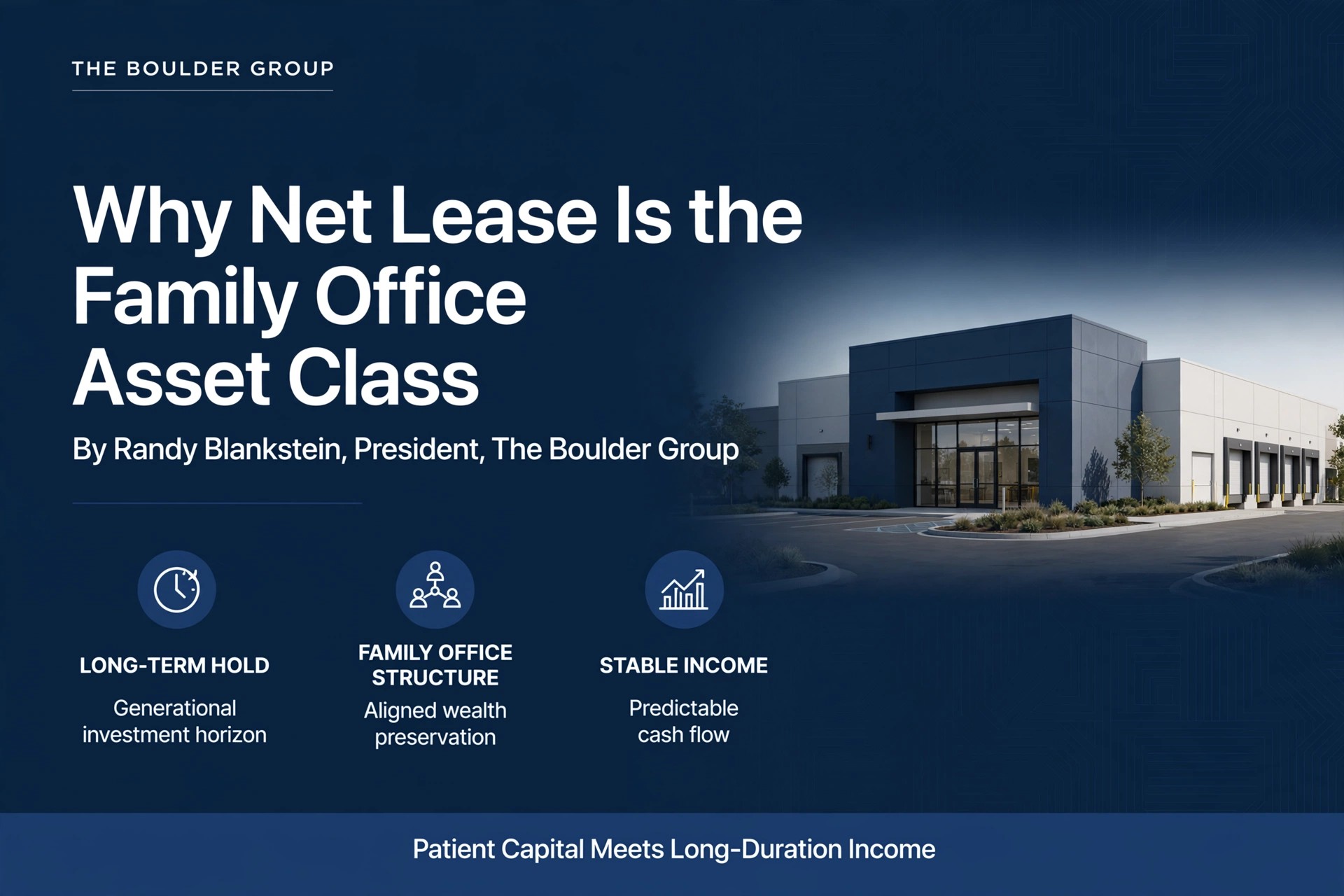
Why Net Lease Is the Family Office Asset Class Date August 6, 2026
By Randy Blankstein, President, The Boulder Group
Over nearly three decades advising net lease investors, I’ve watched the buyer pool move through several eras: the syndicator boom, the rise of the net lease REITs, the 1031 exchange wave, the institutional push into the space. The most consequential shift underway now is quieter than any of those. Family offices are becoming a permanent, structural presence in single tenant net lease — and the asset class fits them better than it fits almost anyone else.
Patient Capital Meets Long-Duration Income
The defining constraint for most institutional real estate investors is fund life. A closed-end vehicle with a seven-to-ten-year horizon has to underwrite the exit as well as the asset, which makes a 15-year corporate-guaranteed lease, paradoxically, a complication. The fund will be selling into whatever residual term remains at disposition, and mid-term rollover is where net lease pricing gets punished.
Family offices don’t carry that constraint. Multi-generational capital can hold a Walmart, a distribution facility, or a ground lease through the full lease term and into the renewal — or through a re-tenanting — without a limited partner agreement forcing a sale at the worst possible moment. Rollover, the single largest structural risk in net lease, shrinks considerably when the holding period is measured in decades rather than fund cycles.
Net lease’s biggest weakness for institutional capital, in other words, is largely neutralized by the family office structure. Patient capital doesn’t just tolerate long-duration leases. It’s the natural owner of them.
The Operating Business Parallel
Most family office wealth in this country traces back to an operating business. First- and second-generation families understand credit. They think of tenants as businesses rather than line items, and they’re comfortable evaluating a guarantor the way they once evaluated a customer or a competitor.
Net lease rewards exactly that skill set. Unlike multifamily or hospitality, where returns depend on operational execution, net lease returns come down to credit judgment and real estate fundamentals settled at acquisition. A family that built a distribution company or a franchise platform is often better equipped to underwrite a tenant’s balance sheet and unit-level economics than a generalist allocator — and net lease lets them apply that edge passively, without standing up an operating platform.
For families moving from a liquidity event into real assets, net lease is frequently the first allocation, and the reason is simple: it behaves like a bond with a deed attached. Contractual income, a hard asset, and none of the management intensity that turns real estate into a second career.
The Estate Planning Dimension
Net lease may be the most estate-friendly asset class in commercial real estate. The assets are divisible and legible — a portfolio of ten single tenant properties can be split among heirs far more cleanly than one operating asset or a fund interest. The 1031 exchange defers gains indefinitely, the “swap till you drop” strategy, and a stepped-up basis at transfer wipes out the embedded gain for the next generation. And because the properties need minimal management, heirs aren’t forced to become real estate operators or rush a sale to escape the workload.
Very few asset classes let a family compound tax-deferred for decades, pass assets with a basis step-up, and hand the next generation something they can actually hold. Net lease does all three.
What the Current Market Offers Family Offices
Timing helps too. Our First Quarter 2026 Net Lease Research Report put single tenant cap rates at 6.80%, with property supply down 9.8% quarter-over-quarter as transaction activity absorbed inventory. More telling is the bifurcation: investment-grade credit with long lease terms still draws deep institutional and 1031 competition, while shorter-lease and sub-investment-grade assets trade at meaningfully wider spreads.
That bifurcation is where family office capital has an edge. A buyer who can hold through rollover, and who can underwrite credit independently rather than outsourcing the judgment to a rating agency, can pick off assets the institutional market is structurally forced to discount. The excess spread in that segment isn’t compensation for risk the family office actually bears; much of it is compensation for a fund-life constraint the family office doesn’t have.
Meanwhile, with institutional allocations tilted heavily toward industrial, competition in retail net lease has thinned. For patient capital seeking durable income from fungible, well-located real estate, the current market offers a broader choice set and more negotiating leverage than at any point in recent years.
Building the Allocation
The families executing this well share a few habits. They set credit standards before yield targets. They treat real estate fundamentals — replacement rent, location durability, re-tenanting prospects — as the floor of the investment, with the lease as the bonus. They build direct relationships with brokers and sale-leaseback deal flow instead of waiting for broadly marketed offerings. And they size positions so that no single tenant event forces a decision.
What they avoid is just as consistent: stretching on lease term to hit a cap rate target, treating a franchisee guarantee as equivalent to corporate credit, and buying real estate they wouldn’t want to own vacant.
The Long View
Every era of net lease has had its marginal buyer — the capital source that sets pricing at the edge. For stretches of the last two decades, that was the REITs, then 1031 exchangers, then institutional funds. I expect the coming decade’s marginal buyer in significant segments of this market to be the family office, for the simplest of reasons: no other buyer’s structure matches the asset’s duration.
Randy Blankstein is President of The Boulder Group, a boutique investment real estate service firm specializing in single tenant net lease properties.
Back